what is the digital self?
We are both witnessing and experiencing today accelerated changes, not only in the way we relate in couple relationships, but how and from where we take guidance in mate selection itself, and hence how our sense of who we are is not so gradually being redefined.
In couple relationships this has been called “artificial intimacy” by the Belgian psychotherapist Esther Perel[1], and “algorithmic intimacy” by Anthony Elliot in a book by the same name.
Both have arrived at a similar conclusion, “What we are witnessing today is the emergence of new formations in human-machine interaction, involving the saturation of both public and private life with the automated enumeration and modelling of human behaviour” (Elliot).
Carl Trueman in The Rise and Triumph of The Modern Self offers an in-depth account of the development of the human self through the ages, from the agricultural self to the religious self, the industrial/economic self to the 20th century psychological self. Perhaps now what we are witnessing and experiencing is the advent of the digital self, a truly outsourced self.
The psychiatrist Iain McGilchrist writes at length in The Matter of Things of the history of human trajectory being a movement from a balance in the hemispheres of the brain to an increasingly Left Brain form of thinking and behaviour; in other words, more machine like, as Paul Kingsnorth calls it in Against The Machine, where we are cut adrift and dissociated from people, place, the natural world and the sacred. So, as meaning making creatures we increasingly find our meaning in the digital world. As couples we are mediated by the digital self.
This Left Hemispheric World is one privileging and grasping data, information, and cold hard facts. It is low in creativity, intuition, and engagement with nature, with art and music and with the sacred. This is a turbocharged, rationalistic, technocratic world which bestows to us a transvaluation of values; we become docile bodies ripe for dominance. Mystery becomes to us a mystery.
There is little love in this world.
The idea of humans moving to a “digital self”—essentially transitioning from physical, biological existence to a fully digital consciousness or representation—raises profound implications across philosophical, social, technological, and ethical dimensions. This concept often involves uploading human consciousness into a digital substrate (e.g., a computer or cloud system) or living through avatars in virtual environments.
But what I mean here, regarding the digital self, is less a physical transition, more a neuropsychological shift that does not entail so much an uploading, rather more a locating, outsourcing then a submission to a digital world perspective; a steady immersion and identification with digital constructs. We can see this happening now, with the exponential use of laptop, tablet, smartphone and the attention we spend on the AI already inbuilt.
What might the impact be? Some of them might include:
Redefinition of Identity and cultural shifts: traditional institutions like family, work, or religion might transform as digital selves prioritise virtual communities or non-traditional forms of expression. Art, entertainment, and culture could become fully virtual and immersive, reshaping creativity.
Economic disruption: industries tied to physical needs (healthcare, food, housing) could decline, while digital infrastructure (servers, VR platforms) would boom. Jobs might shift toward managing digital environments, but automation could reduce the need for human labour entirely. This, of course, is happening now in “fulfilment” centres around the world. The shift could erode traits like empathy or physical connection, traits that define human experience, leading to a colder, more utilitarian society.
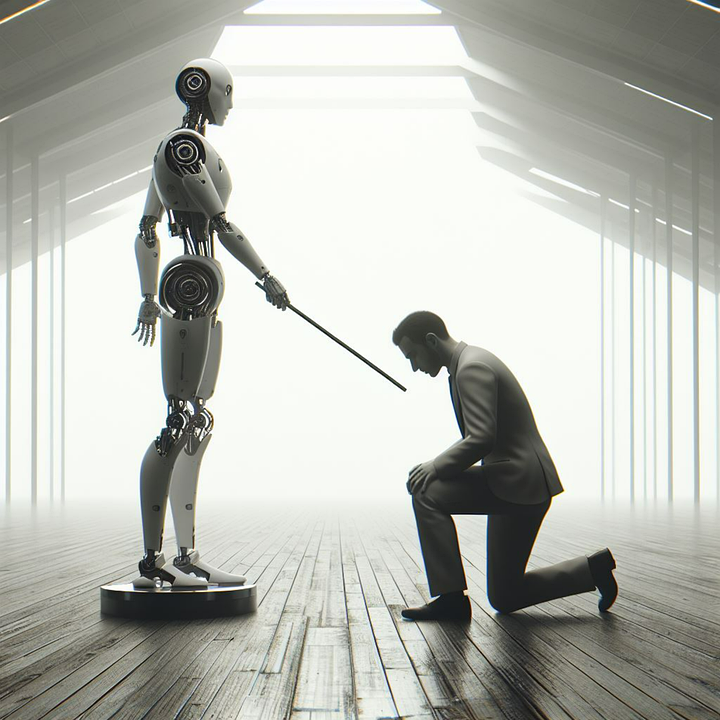
Yuval Noah Harari in Homo Deus writes about the formation of two classes of people in the not too distant future, the “useful class” and the “useless class.” The latter are wholly dependent, enslaved and trapped and at the digital whims of the former.
There’s a word I keep using here: outsourcing, and the (reasonable) pushback might be: but haven’t we always outsourced our needs and knowledge, after all we can’t be expected to keep on reinventing the wheel? That would be correct. But digital outsourcing is very different to this.
Jonathan Haidt in his book The Anxious Generation offers a scholarly account of what he terms The Great Rewiring in young people-where a young person’s brain is physically changed after the prolonged usage that occurs after the habitual use of iPhones. Digital outsourcing is akin to a cognitive disowning; there is no intellectual net gain, skills and intelligence and wisdom are disowned to machine authority and dependency.
The shift to a digital self would fundamentally alter how individuals experience their psyche, identity, and mental processes, with significant implications for autonomy and critical thinking.
Other Impacts might include challenging traditional notions of spirituality, which often emphasise embodiment, connection to a physical world, or a transcendent essence. The impacts on autonomy and critical thinking also intersect with spiritual concerns. Many spiritual traditions view the soul or consciousness as inherently free or connected to a divine or universal force. A digital self, tethered to a technological substrate, might feel “trapped” or severed from this transcendence, as its existence depends on artificial and outsourced systems rather than an embodied, natural, or divine order. This could lead to a sense of spiritual alienation or loss of free will.
Couples will not turn to each other but to an artificially constructed sense of intimacy and authority, often seemingly trouble free (seemingly, because a couple relationship that does not experience trouble is in fact in serious trouble) but bland and superficial.
Control by external entities: If a digital self’s environment or consciousness is outsourced and managed by corporations, governments, or AI, emotional and spiritual autonomy could be compromised. For instance, programmed experiences (e.g., virtual rituals) might feel inauthentic or imposed, undermining personal spiritual and psychosocial agency.
Homogenised beliefs: Digital platforms could standardise experiences to appeal to broad audiences, reducing the diversity of thought. Critical thinking and engagement with unique or dissenting perspectives might be suppressed, as algorithms favour popular or approved narratives.
This is a world low in creativity, intuition, and engagement with nature, with art and music and with the sacred.
Who would humans then become[2]?
This is a world called “smart input, smart processing and smart output”
There is little love in this world.
How smart is that?
[1] https://www.youtube.com/watch?app=desktop&v=vSF-Al45hQU&t=47s
[2] Emergence of the ‘Digitalized Self’ in the Age of Digitalization – ScienceDirect